> San Antonio Local Insight: Hard water mineral deposits (21 gpg from Edwards Aquifer) affect toilet components, garbage disposals, and fixtures throughout local homes. Scale buildup causes premature wear, reduces performance, and creates problems that soft-water cities rarely see. Regular descaling maintenance is essential for San Antonio plumbing.
A disposal’s age matters less than its condition, but local water can shorten the comfortable middle of its service life. Edwards Aquifer water is about 357 mg/L, or 21 gpg. The minerals do not directly “wear out” the motor; they build scale around wet plumbing surfaces, hold residue, stiffen connections, and make corrosion or slow drainage more likely around the appliance.
For a San Antonio home in the Medical Center area—where many kitchens date to 1970s or 1980s construction—judge the whole installation. A dry, quiet ten-year-old unit may be worth keeping. A younger unit with a body leak, repeated resets, or badly corroded fittings may not be. Set aside about $250–$650 for a typical installed replacement, plus more if an electrician must correct unsafe hardwiring or a plumber must realign an aging branch drain.
A homeowner in Medical Center area should be especially careful because 1970s and 1980s builds often have aging valves, supply lines, and remodel-era plumbing mixes. If you are comparing advice from national repair guides, shorten the maintenance interval and inspect for white scale, crusted fittings, stiff shutoff valves, and early corrosion before assuming the part simply “got old.”
For budgeting, use local pricing instead of national averages: drain cleaning usually runs $150-$350, and a sewer camera inspection is commonly $200-$400. If the issue appears after a summer high-use period or after a rare freeze like Winter Storm Uri, treat it as a local risk signal and document what you see before calling a licensed plumber in Bexar County.
How long does a garbage disposal last? There is no single expiration date. Many residential units provide roughly a decade of service, but actual life depends on build quality, frequency of use, what enters the chamber, plumbing conditions, installation, and whether leaks or jams are addressed promptly. A lightly used, well-installed unit may run longer; a heavily used disposal subjected to grease, fibrous waste, and repeated stalls may fail sooner.
Age is only one decision factor. Sound, drainage, leakage, electrical behavior, repair history, and parts availability tell you more about whether a disposal needs a simple correction or sensible replacement.
Understand what “service life” really means
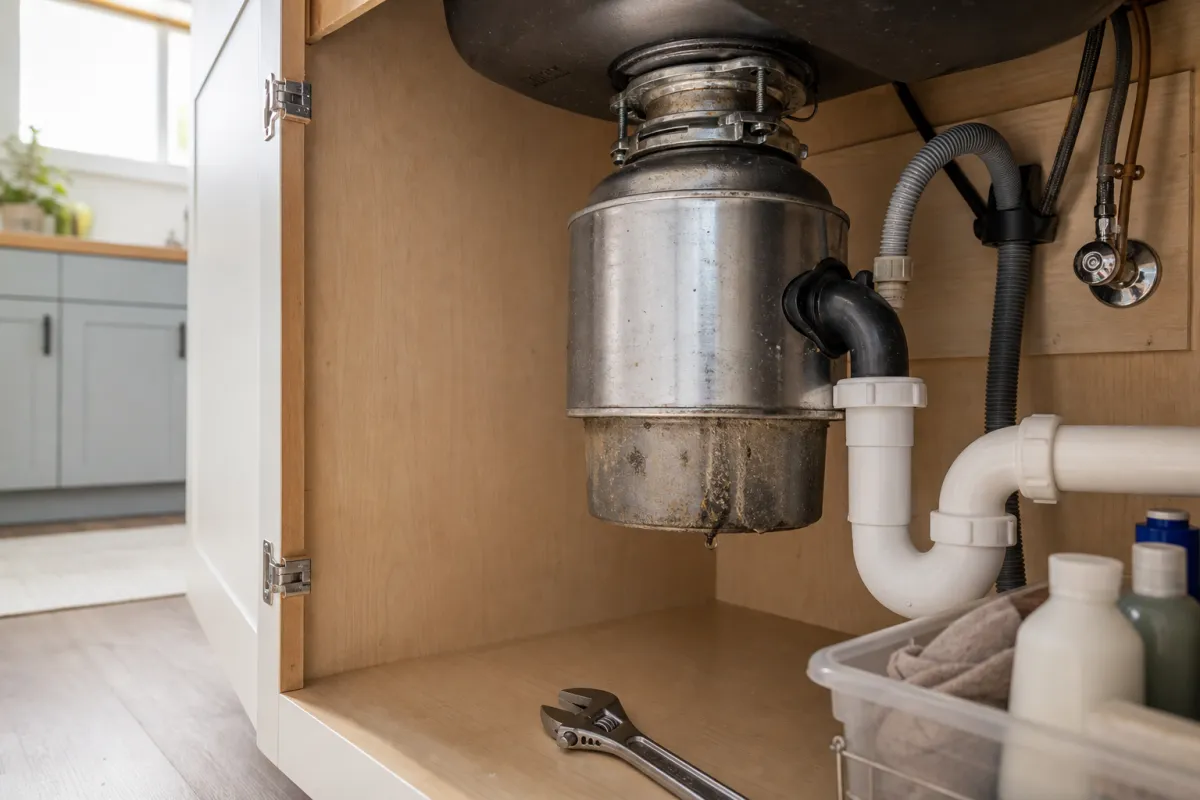
An age range is a planning estimate, not a warranty. A disposal contains a motor, bearings, seals, rotating or swinging grinding components, electrical protection, a mounting assembly, and plumbing connections. These parts do not wear at identical rates. A unit can sound healthy while an internal seal begins leaking, or drain slowly even though the motor is fine because the P-trap is blocked.
Usage matters as much as the calendar. A two-person household that scrapes plates into compost places different demands on a unit than a busy kitchen processing scraps several times a day. Water quality and corrosion can affect metal parts; poor drainage can keep debris near the chamber; vibration from a loose mount can stress joints. Treat the installation as a system rather than blaming every symptom on motor age.
Check the installation date and maintenance history first
Look for a dated invoice, appliance list, home inspection report, model label, or previous owner’s records. The serial number may encode production information, though it does not prove when installation occurred. Photograph the label with power safely off if access is awkward. Knowing the model also helps establish warranty terms, horsepower, dimensions, connection method, and whether parts remain available.
History clarifies the decision. A ten-year-old disposal with one removable jam and no leaks may have useful life left. A younger unit that has overheated repeatedly, leaked into the cabinet, or required frequent resets is less reassuring. Record when symptoms occur: during disposal operation, ordinary sink drainage, or dishwasher discharge. Note whether both sink bowls are affected and whether another fixture gurgles. Those observations help separate appliance failure from a downstream plumbing fault.
Read the warning signs without overdiagnosing
Changes in sound are valuable. Metallic clatter can mean a utensil or other foreign object; a hum without rotation suggests a jam; grinding or rumbling that persists when empty may indicate wear or loose components. Switch off a humming unit immediately to avoid overheating. Isolate power at the breaker or plug before inspecting, and never put a hand through the splash guard.
Slow drainage is not automatically a dying disposal. Food sludge may be caught in the chamber, elbow, trap, or branch line. Odor may come from the underside of the splash guard rather than the motor. Conversely, water emerging from the body seam or bottom—not merely a hose or gasket—often indicates an internal seal or housing failure and generally favors replacement. Breaker trips, sparks, burning odor, damaged wiring, or shock sensation are electrical stop signs, not DIY experiments.
Distinguish repairable faults from end-of-life failures
Common correctable faults include a removable foreign object, a tripped overload after one jam, a worn discharge gasket, a loose dishwasher clamp, or a localized trap blockage. The correct repair depends on the model and installation. One reset after safely freeing a jam is reasonable when the manual permits it; repeatedly pressing reset without fixing the cause is not.
End-of-life cases are more likely when the housing leaks, the motor no longer starts despite confirmed safe power and a freely moving mechanism, bearings are severely noisy, corrosion compromises the body, or failures recur after proper repairs. Parts cost and access matter. Paying substantial labor to repair an old entry-level unit can be poor value if a compatible replacement provides a new warranty and corrects installation issues at the same visit.
Compare repair and replacement with a quick decision table
| Condition | Likely next step | Important caution |
|---|---|---|
| One known foreign-object jam | Isolate power and follow manual | Never reach inside |
| Loose external hose or gasket | Inspect and replace correct part | Protect cabinet and wiring |
| Slow drain with normal motor | Diagnose trap or branch drain | Avoid caustic chemicals |
| Leak from disposal body | Usually replace unit | Stop use near electricity |
| Repeated breaker trips or burning smell | Electrician or qualified service | Do not reset repeatedly |
| Old unit with recurring noise and leaks | Compare full replacement | Confirm plumbing and electrical fit |
Cost comparisons should include more than the appliance price. Replacement may require a new sink flange, discharge alignment, dishwasher connection, cord or hardwire work, and local permit or licensed-trade requirements. A very cheap unit can become expensive if dimensions force plumbing changes. A repair quote should identify the failed component and whether the work carries a warranty.
Do not let sunk cost drive the decision. A recently repaired gasket does not justify another major repair if the housing then leaks. Likewise, age alone does not require removing a quiet, dry, reliable unit. Decide from condition, risk, and total cost.
Choose a replacement that fits the kitchen
Start with compatibility. Measure available cabinet space, note sink material and thickness, inspect drain height, identify the dishwasher inlet, and determine whether the current unit plugs into a receptacle or is hardwired. Match local electrical rules, including grounding and required protection. A licensed electrician should correct questionable wiring rather than transferring it to the new appliance.
Horsepower should reflect household use, but bigger is not automatically better. More powerful units can process ordinary scraps with less labor, yet they may be larger, heavier, and costlier. Sound insulation, stainless grinding components, warranty length, service access, and local parts support may matter more. If the home uses a septic system, check local guidance and avoid assuming a “septic” feature makes inappropriate waste acceptable.
Extend useful life through ordinary habits
Run cold water before and during grinding, feed small amounts gradually, and continue water briefly after the sound clears. Scrape plates into trash or compost first. Keep grease, oil, bones, shells, pits, fibrous husks, celery strings, large quantities of peels, expandable starches, glass, metal, and nonfood items out. No disposal design eliminates the need for restraint.
Clean the removable splash guard with dish soap after disconnecting power; odor-causing film commonly hides beneath it. Inspect the flange, discharge elbow, trap, dishwasher hose, cabinet floor, cord, and receptacle monthly for moisture or damage. Do not use caustic drain cleaner, mix household chemicals, or pour boiling grease into the sink. These habits protect both the appliance and pipes, though they cannot reverse worn bearings or failed internal seals.
Avoid expensive mistakes when a unit acts up
Continuing to energize a humming disposal can overheat it. Repeated resetting can hide an unresolved jam or electrical problem. Forcing the bottom wrench, striking the housing, or reaching through the opening creates injury and damage risks. If the cabinet is wet, do not touch electrical connections until power is safely isolated and the source is assessed.
Another common mistake is replacing the disposal before diagnosing drainage. If both sink bowls back up or water returns from another connection, the clog may be downstream. The opposite mistake—repairing external plumbing while ignoring a body leak—can damage cabinetry. Use dry paper under individual joints to locate minor drips, but treat it as a diagnostic aid, not a permanent fix. Wastewater requires gloves, containment, and cleaning after repair.
Plan replacement before an emergency
If a unit is approaching the later part of its expected service life and shows increasing vibration, intermittent starts, corrosion, or multiple leaks, gather replacement information before it stops during a busy week. Save the model label, measure the cabinet, and obtain an itemized quote. Planning allows time to compare warranty and installation quality rather than choosing whatever is immediately available.
Protect the surrounding cabinet while deciding. Stop using a leaking unit, dry the area, and inspect for swelling or hidden dampness. Do not leave a pan as a long-term solution. If sewage odor, widespread backup, mold-like growth, or electrical moisture is present, professional assessment is more urgent. A planned replacement is less disruptive than an emergency involving damaged cabinetry or an unsafe outlet.
Know when to call a plumber or electrician
Call a plumber for an internal leak, recurring clog, failed sink flange, corroded piping, misaligned discharge, sewage odor, dishwasher backup, or uncertainty about whether the branch drain is clear. A qualified installer can verify mounting, seals, and drainage while ensuring the unit’s weight is properly supported by the sink assembly.
Call a licensed electrician for repeated tripping, sparking, heat discoloration, a damaged cord or receptacle, shock or tingling, standing water near wiring, or questionable hardwiring. Turn off the appropriate breaker if safe and do not restore power for another test. Professional help is also sensible when access is restricted, shutoffs do not work, local rules require licensed work, or physical lifting beneath the sink cannot be done safely.
Frequently asked questions
Can a garbage disposal last 15 years?
Yes, some do, especially with moderate use and good installation, but age does not guarantee condition. Inspect for leaks, corrosion, noise, and electrical issues rather than relying on the number alone.
Is it worth repairing a ten-year-old disposal?
A minor external gasket or removable jam may be worthwhile. A body leak, major motor fault, or repeated failures often makes replacement better value after labor and warranty are compared.
Does a more powerful disposal last longer?
Not necessarily. Adequate power can reduce strain, but materials, installation, habits, water conditions, and build quality also determine longevity.
Why does my disposal work but drain slowly?
The restriction may be in the chamber, elbow, trap, or downstream branch line. Avoid chemical drain cleaner and have persistent or multi-fixture backups diagnosed.
Should I replace a disposal before it fails?
Not solely because of age. Proactive replacement is reasonable when age combines with leaks, corrosion, intermittent operation, or repeated repairs.
Why This Is Different in San Antonio
The local issue is the combination of very hard Edwards Aquifer water, long cooling seasons, and plumbing that ranges from historic metal pipe to newer PEX installations. At 357 mg/L (21 gpg), mineral scale accumulates quickly on continuously wet surfaces. SAWS water-quality reporting is useful context, but scale does not prove that every failure was caused by water chemistry; diagnose the actual leak, restriction, or electrical symptom.
Season also matters. Summer cooking and heavy household use load kitchen drains, while a freeze event like Winter Storm Uri can expose already stressed fittings in an unconditioned cabinet or exterior wall. Bexar County homeowners should inspect after a hard freeze, but never energize a wet disposal or force a brittle connection.
What San Antonio Homeowners Pay (2026)
| Service | Typical local range |
|---|---|
| Condition diagnosis | $85–$150 per hour |
| Minor gasket or connection repair | $150–$325 |
| Installed disposal replacement | $250–$650 |
| Electrical or drain correction | $175–$500+ |
These are planning ranges, not quotes. Access, disposal model, corroded fittings, outlet condition, after-hours timing, and cabinet damage determine the final total. Ask for an itemized scope before approving work.
When to Call a San Antonio Plumber
Call a licensed plumber for a repair-versus-replacement decision, wastewater backup, a shutoff that will not close, or work that requires changing the flange, trap, or wall connection. Stop immediately and use a licensed electrician when water reaches wiring, a breaker trips repeatedly, the receptacle is scorched, or the unit is improperly hardwired. DIY cleaning is reasonable only while power is isolated and the work stays within the manufacturer’s instructions.
When booking service, describe when the symptom occurs, whether the dishwasher is involved, and what you already tested. Ask whether the technician regularly works with hard-water scale and older Bexar County plumbing. That information produces a more useful diagnosis than requesting a generic “tune-up.”
San Antonio FAQ
Does 21 gpg hard water automatically ruin a garbage disposal?
No. The minerals mainly create scale on wet surfaces and contribute to residue retention and corrosion around connected plumbing. Correct use, a dry cabinet, and prompt attention to slow drainage or leaks matter more than aggressive chemical treatment.
Should I install a water softener for this problem alone?
Not solely for one disposal symptom. A softener may make sense when the household also has repeated scale at faucets, valves, showers, and the water heater. Evaluate the full plumbing system and ongoing salt and maintenance costs; a typical whole-home installation can run about $1,500–$4,000.
Who should handle permits or code questions?
For altered plumbing or electrical work, use licensed trades who can confirm the current requirements that apply to the address. That is especially important when a direct appliance swap turns into drain relocation, receptacle work, or repair inside a wall.