Quick answer: Do not choose a tankless heater by brand ranking alone. In San Antonio, the best unit is the exact model that meets peak hot-water demand at the required temperature rise, fits the available gas/electrical/venting capacity, has isolation valves for descaling, and can be serviced locally. Rinnai, Navien, Noritz, Rheem, Bosch, and Stiebel Eltron all have products worth comparing—but not for the same house or fuel setup.
A strong quote starts with a load calculation and site survey. A weak quote starts with “this is our best seller.”
Shortlist by application
| Application | Brands/product families to compare | Main verification |
|---|---|---|
| Whole-home natural gas or propane | Rinnai, Navien, Noritz, Rheem | Flow at design temperature rise, gas input, venting, condensate, recirculation options |
| Condensing gas retrofit | Navien, Rinnai, Noritz, Rheem | Existing gas capacity, vent route, drain for condensate, freeze protection |
| Point-of-use electric | Stiebel Eltron, Bosch, Rheem | Voltage, amperage, breaker spaces, wire size, expected flow |
| Whole-home electric | Stiebel Eltron, Rheem, Bosch where suitable | Service/panel capacity and realistic winter flow—often the limiting factor |
| Home prioritizing local service | Any brand with trained local support and stocked parts | Who services it, parts lead time, warranty process, annual maintenance cost |
Use each manufacturer’s current product selector and official specification sheet. Product families change, and features such as recirculation, Wi-Fi, stainless heat exchangers, or built-in pumps are model-specific.
Size from simultaneous demand, not bathroom count
Tankless output changes with temperature rise. The same unit delivers fewer gallons per minute when it must heat colder incoming water to the same outlet temperature.
Make a peak-use worksheet:
| Fixture running at the same time | Planning flow to verify | Include? |
|---|---|---|
| Shower 1 | Use actual fixture rating | |
| Shower 2 | Use actual fixture rating | |
| Kitchen faucet | Use actual fixture rating | |
| Dishwasher/clothes washer hot fill | Check appliance/manual | |
| Other fixture | Measure or use product rating |
Add only the fixtures that realistically overlap, then ask the installer to show the selected model’s flow at the design temperature rise—not its maximum headline GPM. Oversizing can waste money; undersizing produces temperature drop or flow limits during peak use.
Fuel and infrastructure can decide the brand for you
Gas models
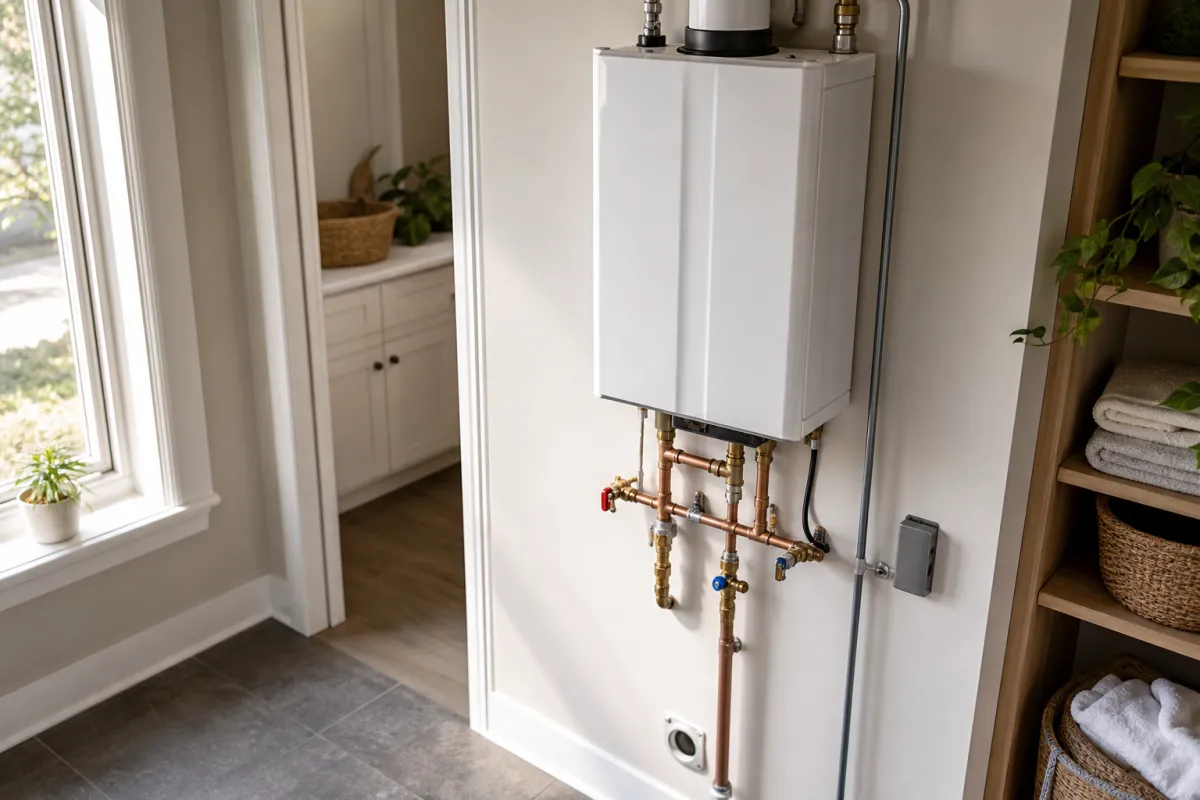
A high-input gas tankless unit may need more fuel capacity than the existing tank heater. The survey should verify meter/regulator capacity, gas-line size and length, pressure under load, venting route, combustion-air requirements, and condensate disposal for condensing models. A brand is not a good fit if the house cannot support the model safely without major work.
Electric models
Whole-home electric tankless units can require multiple high-amperage breakers and substantial service capacity. “No vent needed” does not mean “easy retrofit.” Ask for the model’s total connected load, required breakers, conductor sizes, and a panel/service assessment. Point-of-use electric units are often a more realistic application.
San Antonio hard water: design for maintenance access
SAWS explains that naturally occurring calcium carbonate from local aquifer sources makes water hard and currently describes supplied water as typically 15–20 grains per gallon. Check the current SAWS water-quality report and water-quality FAQ for your supply, then test at the house because source blending and premise plumbing can change the result.
That range matters: published Rinnai installation guidance and Noritz warranty documentation use water-quality thresholds around 200 mg/L or 12 gpg for relevant products—below SAWS’s typical range. No brand should be sold as “hard-water proof.” Require the installer to identify the exact model’s limit, treatment requirement, and warranty exclusion in writing.
Scale can restrict a tankless heat exchanger and inlet screen. A maintainable installation should include:
- manufacturer-approved isolation/service valves;
- reachable inlet filter or screen;
- clearance for hoses and a descaling pump;
- accessible condensate components on condensing units;
- documented freeze-protection requirements;
- a maintenance interval based on the manual and actual water conditions.
Do not accept an installation that hides service points behind permanent cabinetry or makes routine isolation impossible. Water treatment may reduce scale, but it does not eliminate inspection and descaling.
Brand-by-brand: useful distinctions
Rinnai
Rinnai is a major gas tankless specialist with condensing and non-condensing residential lines. Compare venting options, recirculation configuration, controls, flow at temperature rise, and the availability of local trained service. Do not assume every model has the same pump, recirculation logic, or warranty.
Navien
Navien is known for high-efficiency condensing gas units, and selected models include recirculation-oriented features. Condensing equipment needs a compliant condensate path. Verify model-specific pump behavior, venting, gas input, controls, and parts/service access.
Noritz
Noritz offers gas tankless products across different capacities and venting configurations. It belongs on the shortlist when a local installer supports it and can show a model that fits the calculated load. Compare service clearances and freeze-protection details.
Rheem
Rheem spans gas and electric tankless products, which makes brand-level recommendations especially risky. Compare the exact fuel type, required infrastructure, flow curve, warranty, and local service network. A small electric point-of-use unit and a high-input condensing gas unit solve very different problems.
Bosch
Bosch offers compact electric and gas water-heating products in selected lines. Confirm current product availability, application, electrical or venting requirements, and local parts support. Do not select by compact dimensions before checking output.
Stiebel Eltron
Stiebel Eltron is a key electric-tankless brand, especially for point-of-use and electric applications. Its whole-home models still require enough panel and service capacity. Ask an electrician to verify the load rather than relying on an online sizing label alone.
Efficiency: compare UEF and the whole retrofit
Uniform Energy Factor helps compare models in the same category, and ENERGY STAR’s certified product resources can narrow the shortlist. Efficiency should not be considered alone.
A slightly higher-efficiency model may not recover a costly gas-line, venting, panel, or service upgrade. Ask for:
1. product and installation price;
2. required infrastructure work;
3. expected annual maintenance;
4. warranty terms and labor coverage;
5. current utility/fuel assumptions;
6. available rebate or tax-credit eligibility for the exact model and installation date.
For 2026 buyers, do not count on the former federal natural-gas water-heater credit: the cited Energy Efficient Home Improvement Credit applied only to qualifying products installed through December 31, 2025. Verify any newer local utility rebate or replacement program directly before using it in the payback calculation; see the IRS credit page.
Recirculation: convenience with design consequences
Recirculation can reduce the wait for hot water, but the plumbing layout and control strategy determine results. A dedicated return line, crossover valve, learned schedule, demand button, and always-on pump behave differently. Poorly controlled recirculation can increase heat loss.
Ask the installer to draw the loop, explain the control logic, and state whether the selected model includes a pump or requires external components. Do not accept “instant hot water” as a complete design description.
Quote comparison worksheet
| Scope line | Bid A | Bid B | Bid C |
|---|---|---|---|
| Exact model and UEF | |||
| Flow at design temperature rise | |||
| Gas/electrical capacity work | |||
| Venting and combustion air | |||
| Condensate handling | |||
| Isolation/service valves | |||
| Recirculation design | |||
| Permit and inspection | |||
| Annual descaling/service price | |||
| Product and labor warranty |
This table exposes why two “tankless installation” prices can describe different systems.
When tankless is the wrong move
Keep or replace with a tank when the house lacks affordable gas/electrical capacity, peak demand exceeds practical tankless output, maintenance access is poor, the retrofit cannot meet venting/condensate requirements, or the household values simple repairability over space and on-demand operation.
Tankless is also a weak choice when the owner will not fund regular descaling in hard water. The equipment may be efficient, but neglected scale can erase the benefit.
Safety and professional boundary
Gas-line sizing, combustion, venting, high-amperage circuits, pressure relief, condensate, and permit work belong with qualified professionals. Stop DIY work for gas odor, soot, scorching, repeated breaker trips, active leaks, or unsafe venting. Follow the exact installation manual and local authority requirements.
Bottom line
Shortlist brands only after calculating demand and surveying the house. Then choose the model with the best combination of verified output, maintainable installation, local service, parts availability, warranty, and complete installed cost. In San Antonio, service valves and a realistic descaling plan are not optional extras—they are part of selecting the heater.
FAQ
Which tankless brand lasts longest in hard water?
There is no defensible universal winner. Installation, water conditions, maintenance, usage, and local service strongly affect life. Compare exact heat-exchanger design, maintenance instructions, parts, and warranty.
Is gas or electric tankless better?
Gas usually supports higher whole-home flow, but it may require gas and venting work. Electric avoids combustion but can require major electrical capacity. The house survey decides.
Do tankless heaters need annual service?
Follow the exact manufacturer interval and adjust based on water conditions and observed scale. San Antonio hard water often justifies frequent inspection and descaling, but do not invent a universal interval.
What should I read next?
Review water-heater lifespan and replacement signals, compare local hard-water faucet ownership, or request a scoped local quote.